
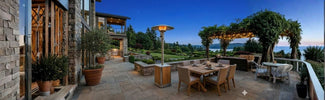
Which patio heater to choose?
, 14 min reading time
, 14 min reading time
#VALUE!
A well-chosen patio heater lets you spend more time outdoors, even when the temperature drops. Whether you want to warm a cosy garden area, a covered terrace, a balcony or a hospitality terrace, the right patio heating can turn a short outdoor stay into genuinely comfortable outdoor living.
But which patio heater should you choose? That depends on your terrace, how sheltered the space is, the heating range you need, the installation position and whether you prefer electric or gas. In this guide, you will learn what to look for, which mistakes to avoid and which models are suitable for different situations.
The best patio heater is not always the most powerful model. What matters most is the right combination of power, heating range, placement and intended use. An open terrace, for example, requires a different heating solution than a sheltered veranda.
| Terrace type | Recommended patio heater | Why? | Pay attention to |
|---|---|---|---|
| Open terrace | Powerful infrared heater or gas heater | Less heat loss in windy conditions | Choose enough power |
| Covered terrace | Electric wall heater | Targeted heat and fixed placement | Check mounting height |
| Balcony | Compact electric heater | Space-saving and easy to use | Check socket access and safety |
| Hospitality terrace | Multiple heaters per zone | Even warmth for guests | Work with zones, not one central point |
An electric patio heater is usually the best choice for a fixed seating area, veranda, balcony or covered terrace. These models provide quick warmth, are easy to operate and can often be mounted on a wall or ceiling.
Electric patio heating is especially useful when you want targeted warmth. Instead of heating all the outdoor air, it mainly warms the area where you are sitting.
A gas patio heater is practical when you want flexibility and do not have a fixed power outlet available. Gas heaters are often movable and also create atmosphere thanks to the visible flame.
Never use gas heating in enclosed or poorly ventilated spaces. Because combustion takes place, sufficient ventilation is essential.
| Choice | Best for | Advantage | Disadvantage |
|---|---|---|---|
| Electric | Fixed seating area, veranda, balcony | Targeted, fast and space-saving | Power outlet required |
| Gas | Flexible setup | Movable and atmospheric | Gas cylinder and ventilation required |
With patio heating, the way heat is produced and transferred plays an important role. Not every heater warms in the same way. Especially with electric patio heaters, the difference between short wave, medium wave and long wave matters.
Short-wave infrared directly heats people and objects. This works well on open or windy terraces because the heat is less quickly lost through the surrounding air.
Medium-wave infrared is suitable for sheltered outdoor areas. It provides comfortable warmth but is slightly more affected by wind than short-wave infrared.
Long-wave heating mainly warms the air. This works best in enclosed or very sheltered spaces, but less effectively on open terraces where wind carries the warmth away.
A hanging or wall-mounted patio heater is ideal for a fixed seating area. It saves floor space and directs the warmth exactly where you need it.
This solution works well under a canopy, near a lounge set or against an exterior wall. Always pay attention to the correct mounting height and safety distance from furniture, fabric and wood.
A standing patio heater is suitable when you want to use the heater in several places. This is useful for changing seating arrangements or larger terraces.
The disadvantage is that a standing model takes up floor space. With electric models, a power outlet must also always be nearby.
The required power depends on the size of your terrace and how open or sheltered the space is. A small balcony needs less power than an open garden seating area or hospitality terrace.
| Surface area | Sheltered spot | Open spot | Recommended choice |
|---|---|---|---|
| Up to 10 m² | 1400 W | 1400–2000 W | Compact electric heater |
| 10–16 m² | 2000 W | 2000 W or multiple heaters | Powerful infrared heater |
| More than 16 m² | Multiple heaters | Multiple heaters or gas | Zone heating |
This Solamagic ECO+ 2000W is suitable for anyone looking for a more powerful electric patio heater for a larger seating area. With a heating range of up to 16 m², this model is ideal for spacious terraces, canopies and fixed outdoor zones.
The nano anthracite finish gives the heater a modern appearance. Thanks to wall mounting, the floor remains clear and the heat is distributed in a targeted way.
This 1400W version is a strong choice for smaller or well-sheltered terraces. The model provides targeted warmth without unnecessary overcapacity and fits well in modern outdoor spaces.
Thanks to its lower consumption, this model is appealing for regular use in a compact area. The nano anthracite colour creates a calm and stylish finish.
This white Solamagic ECO+ 1400W offers the same practical performance as the anthracite version, but with a lighter look. This makes it suitable for light-coloured walls, white canopies or terraces where the heater should blend in subtly.
With a range of up to 12 m², this model is suitable for compact seating areas where comfort, design and ease of use are important.
| Model | Power | Range | Best for |
|---|---|---|---|
| Solamagic ECO+ 2000W Nano Anthracite | 2000 W | Up to 16 m² | Larger seating areas |
| Solamagic ECO+ 1400W Nano Anthracite | 1400 W | Up to 12 m² | Compact modern terraces |
| Solamagic ECO+ 1400W White | 1400 W | Up to 12 m² | Light-coloured walls and canopies |
Choose a patio heater based on your terrace size, level of shelter and preferred placement. For fixed seating areas, an electric wall heater is often the most practical choice.
Electric is usually better for targeted warmth and fixed mounting. Gas is especially useful when you want to move the heater often and do not have a power outlet.
For a compact, sheltered spot, 1400 W is often enough. For larger or less sheltered terraces, 2000 W or more is usually more suitable.
Yes, many electric patio heaters are suitable for installation under a canopy. Always check the mounting height, safety distance and manual.
Choose a low glare or modern infrared heater if you want less visible glow. These models provide warmth with less bright red or orange light.
Doika helps you not only compare, but also make the right decision. By choosing based on terrace size, shelter, placement and power, you avoid buying a heater that is too weak, too large or impractical.
Doika offers a carefully selected range of patio heaters for anyone who wants to sit outside comfortably for longer. At Doika, you will find clear product information, strong models for fixed mounting and reliable choices for different terraces. You also benefit from service, warranty on your purchase and support in choosing the patio heater that suits your outdoor space.
Which patio heater you choose depends on your terrace, the level of shelter, the heating range and your preferred placement. For fixed seating areas, an electric infrared wall heater is often the most practical solution, while gas can be useful for flexible setups. View the range via patio heaters and choose a heater that suits your situation.


