
What Size Compost Bin Should I Buy?
, 6 min reading time
, 6 min reading time
Composting is rapidly gaining popularity — and for good reason. It’s a sustainable way to turn kitchen and garden waste into nutrient-rich compost. But anyone looking to buy a compost bin is immediately faced with an important question: how big should the compost bin I buy be? This choice is crucial. A bin that’s too small will lead to frustration and overflow, while one that’s too large may slow down the composting process.
In this article, we explain how to choose the right size compost bin for your situation. We’ll cover waste volume, household size, garden type, and composting frequency. This way, you’ll make a well-informed decision and enjoy optimal composting results.
A compost bin works best when it’s properly filled — not too empty, and not overflowing. The breakdown of organic material requires a balanced ratio of moisture, oxygen, and mass. Too little volume results in poor heating and slow composting. Too much material without enough aeration leads to rotting and odors.
In short, the right compost bin size affects:
The amount of organic waste you produce directly relates to the number of people in your household:
Household Size Average Organic Waste/Week Recommended Compost Bin
1–2 people 5–10 liters 100–150 liters
3–4 people 10–20 liters 200–300 liters
5+ people 20–40 liters 300–600 liters
Also consider pets or other sources of compostable waste.
If you have a large garden, your garden waste may exceed your kitchen waste. Think grass clippings, leaves, prunings. In that case, opt for a larger compost bin or consider an open compost heap as an addition.
Tip: Do you generate lots of wet kitchen waste? Mix it with dry leaves or shredded cardboard for the ideal carbon-to-nitrogen ratio.
If you want to compost continuously, you’ll need at least two bins: one for active use, one for maturing. This way, you always have one bin available without interruption. Each bin should hold 3–6 months' worth of waste.
Have a city garden or balcony? Then choose a compact bin (50–150 liters) or a rotating compost tumbler. For larger gardens, a stable compost bin of 300 to 600 liters is recommended.
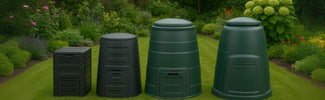
Let’s take a closer look at some common sizes:
At Doika, we often hear feedback from customers about their composting setups. Here are some real-life examples:
“We’re a family of three and chose a 300-liter compost bin. It’s perfect. In summer, it fills up in two months; in winter, it takes longer. Thanks to the ventilation holes, there’s minimal odor.”
– The Van der Velde family, Ghent
“Our family of five produces a lot of organic waste. So we have two 400-liter bins. While one matures, we fill the other.”
– Pieter, Leuven
“As a single person, I was worried composting would be a hassle. But my 100-liter bin fits perfectly on the balcony. I use compost accelerator and turn it regularly – ideal!”
– Ines, Antwerp
Watch out for these pitfalls:
At Doika, we believe in sustainable living made easy. That’s why we offer a carefully curated selection of compost bins in various sizes, styles, and materials:
Our product pages include clear specifications, customer reviews, and helpful tips. Plus, we offer free advice via chat or email.
A bin is “full” when you can’t mix in new material without overflow. Stop adding and let it mature (6–12 weeks). Start a new bin in the meantime.
Tip: Use a screen to separate large bits from ready-to-use compost.
Living in an apartment? Consider:
We work with suppliers specialized in eco-friendly garden solutions. Our customer service team has hands-on experience with gardening and composting.
Doika regularly publishes in-depth blog articles, buying guides, and how-to content on sustainability. We delve deep into materials, techniques, and user insights.
With thousands of satisfied customers, positive reviews, and a wide product range, Doika has become a leading name in eco garden solutions in Belgium and the Netherlands.
Consider your waste volume, available space, composting goals, and usage frequency. Doika is here to help you make the right choice.
Want to make the most of your kitchen and garden waste? Start composting the right way today. Explore our selection of compost bins in various sizes and order with confidence.
👉 Visit our compost bin collection and start sustainable composting


