
From what age is a sand and water table suitable?
, 12 min reading time
, 12 min reading time
Choosing a sand and water table based on age may seem straightforward, but there is no verified universal minimum age for the models discussed here. What matters more is whether your child can sit or stand steadily in the intended play position, has enough coordination to handle sand, water and play materials, and how much assistance is still needed. The design of the table also matters. A model without integrated benches requires a different play position from one that also allows a child to play while seated. In this guide, you will learn which signs to look for, how the three available configurations differ and which option best suits the way your child plays.
There is no verified fixed starting age for the sand and water tables discussed here. Instead, focus on your child’s development: can they sit or stand steadily, use play materials purposefully and handle sand and water with appropriate supervision? A model with benches allows seated play, while a version without integrated seating is mainly used from a suitable standing position. The younger or less independent a child is during play, the more important direct supervision becomes. Extra features such as a parasol, benches or gardening tools do not by themselves determine the age from which a table is suitable.
The play position should match the table design. A model with integrated benches allows a child to play while seated, whereas a version without fixed seating is mainly used from a suitable standing position.
Scooping, filling, pouring and moving materials between containers require a child to grasp and use objects purposefully. Focus on what your child can already do in practice rather than linking these abilities to a fixed age.
Playing with sand and water involves different activities from using a standard activity table. Consider whether your child can handle loose materials in a way that matches the level of supervision you can provide.
Children differ in how independently they play. Some still need considerable help with filling, scooping and switching between activities, while others can perform the same actions more independently.
Appropriate supervision remains important when children play with water and loose play materials. How actively you need to supervise depends on the child, the activity and the materials being used.
A basic sand and water table, a version with two benches and a model with additional accessories each provide different ways to play. The choice should therefore be based not only on age, but also on play position, independence and the features that will actually be used.
A basic sand and water table is particularly suitable when standing play is sufficient and integrated seating is unnecessary. A version with two benches offers greater flexibility because the child can play both seated and standing. If additional outdoor activities are important, a version with a parasol and gardening tools may be more suitable. These extra features do not change the minimum age, but they can affect which table is more practical for the intended use.
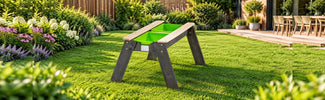
The EXIT Aksent sand and water table is the simplest of the three versions discussed. It focuses on sand and water play without integrated benches and combines two removable containers with a tabletop that can be closed with a cover.
This version combines sand and water play with two integrated benches. This allows a child to play both seated and standing, while the closed tabletop can also be used for other table activities.
This version offers the same combination of seated and standing play while adding a parasol and gardening tools. It therefore has the most extensive accessory package of the three models discussed.
| Model | Play position | Extra features | Cleaning | Best for |
|---|---|---|---|---|
| Aksent sand and water table | Mainly standing | Cover for table activities | Removable containers | Simple configuration |
| Aksent picnic table with 2 benches | Seated and standing | Benches and cover | Removable containers | Flexible play position |
| Aksent picnic table with benches, parasol and gardening tools | Seated and standing | Benches, parasol and gardening tools | Removable containers | Most complete configuration |
The basic sand and water table is suitable for those mainly looking for standing sand and water play without integrated seating. The model with two benches is more suitable when your child should be able to play both seated and standing. The version with two benches, a parasol and gardening tools suits those who want the same flexibility while also valuing additional outdoor activities and accessories.
There is no verified universal minimum age for the models discussed. Focus instead on whether your child can sit or stand steadily, has sufficient coordination and how much assistance is needed during play.
Not always. A model with integrated benches allows seated play, while with a version without benches you should assess whether the intended standing play position is suitable for the child.
Benches provide a fixed seating option, but they do not automatically determine the age from which a table is suitable. Stability, coordination, handling of the materials and supervision remain important.
Appropriate supervision remains important when playing with water and loose play materials. How actively you supervise depends on the child, the activity and the materials being used.
Doika helps you compare sand and water tables using clear, verifiable product features such as play position, integrated benches, removable containers, ease of cleaning, the cover and included accessories. This makes it easier to compare the different versions without relying on unverified minimum ages or invented product details. You also receive clear product information, customer service, delivery, return options and warranty according to the applicable product conditions.
There is no verified universal starting age for the sand and water tables discussed. Focus primarily on stable sitting or standing, coordination, independence and supervision. View all sand and water tables or compare the sand and water table, the version with 2 benches and the model with parasol and gardening tools.


